
For more than 70 years, a towering granite cross on Saartjiesnek has welcomed travellers to Hartbeespoort. But few people know the fascinating and controversial history behind this familiar landmark.
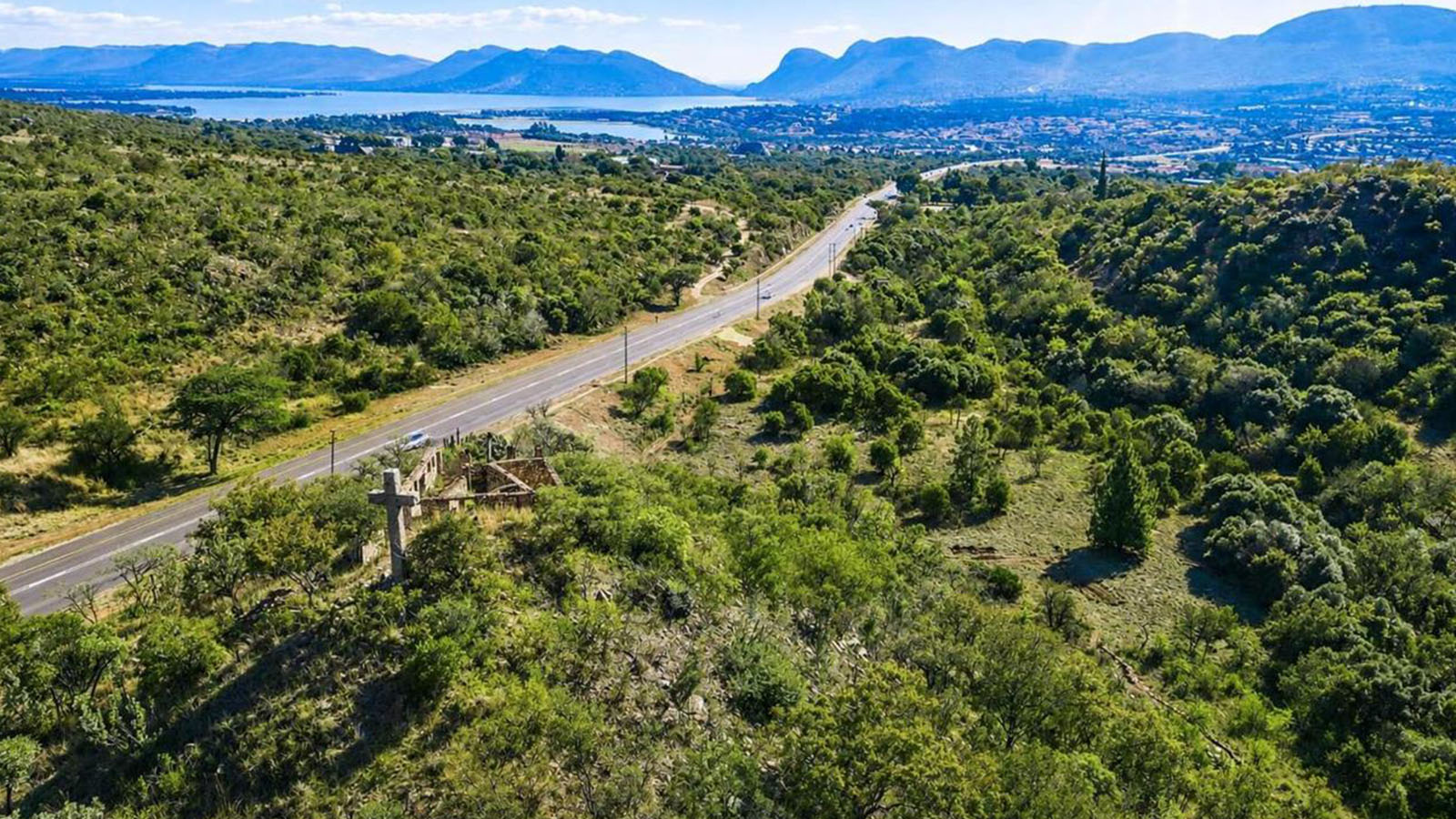
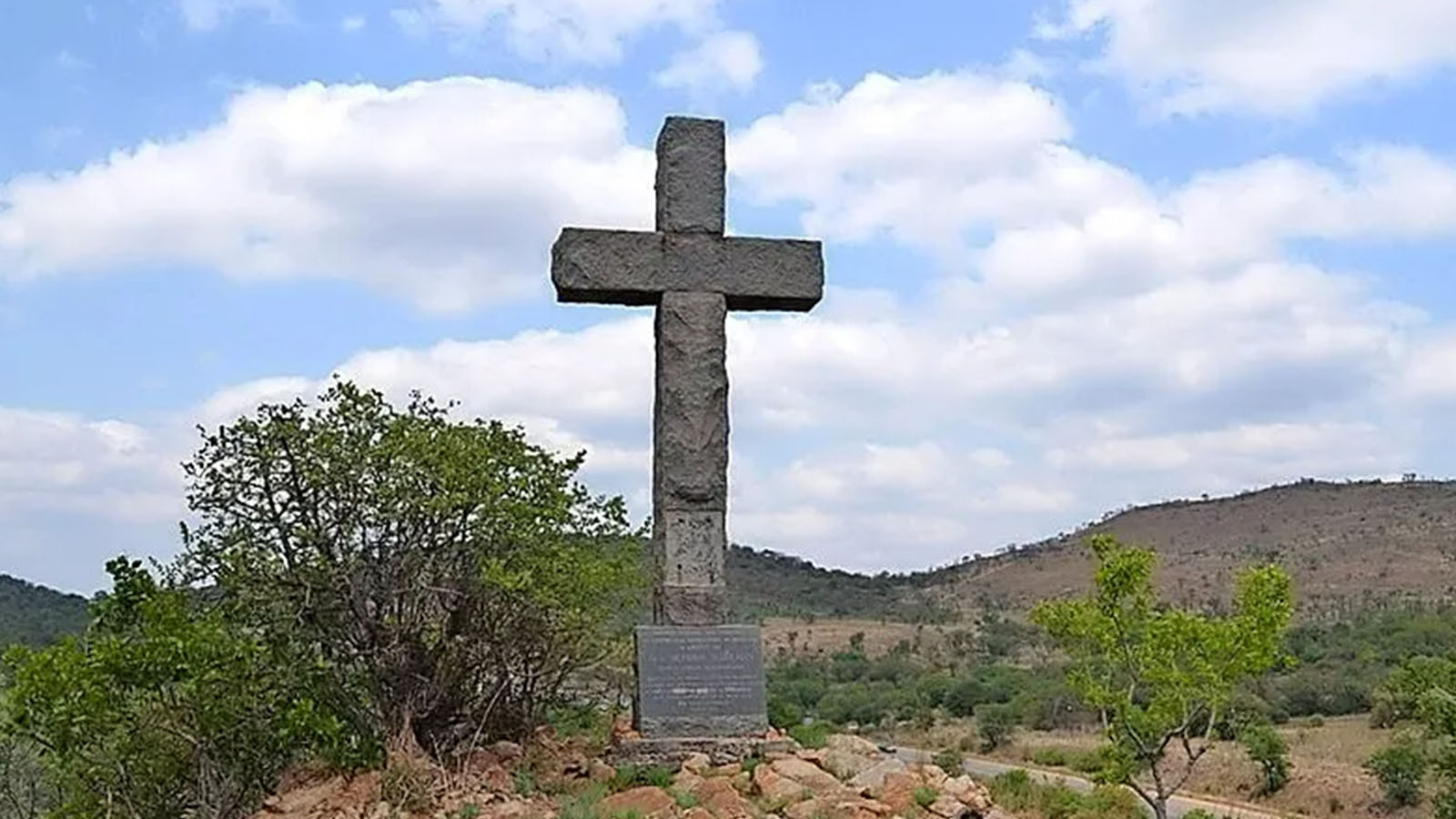
The four-metre-high granite cross on Saartjiesnek was erected on Christmas Day 1955 by Johan Schoeman in memory of his father, General Hendrik Schoeman. Today it is one of Hartbeespoort’s best-known landmarks.
For thousands of motorists travelling from Pretoria and Johannesburg towards Hartbeespoort, the sight of a large cross standing on a rocky hilltop at Saartjiesnek signals something special — they are almost home.
Perched above the R511, overlooking the picturesque Hartbeespoort valley, the four-metre-high granite monument has become one of the area’s most recognisable landmarks.
Yet the cross is not simply a religious symbol. It tells a story of family devotion, political controversy, the Anglo-Boer War and one man’s determination to honour his father.
A monument erected on Christmas Day
The cross was erected on 25 December 1955 by Johan Schoeman in memory of his father, General Hendrik Schoeman, a prominent but controversial figure in the history of the former Zuid-Afrikaansche Republiek (ZAR).
Johan Schoeman wanted to commemorate his father’s efforts to negotiate peace during one of the most turbulent periods in South African history.
He chose a prominent hilltop at Saartjiesnek, where the monument would be visible to generations of travellers entering the Hartbeespoort valley.
The hill subsequently became known as Kruiskoppie — literally, Cross Hill.
The monument has stood there ever since, surviving decades of development as Hartbeespoort grew from a rural farming community into a popular residential and tourist destination.
Who was General Hendrik Schoeman?
General Hendrik Schoeman (1840–1901), also known as Hekkie Schoeman, was a Boer military commander and political figure whose life became entangled in the conflicts of the late nineteenth century.
He settled in the Hartbeespoort valley along the Crocodile River in 1868, long before the construction of Hartbeespoort Dam.
Schoeman became an influential landowner and was involved in the political affairs of the Transvaal Republic.
During the Anglo-Boer War of 1899–1902, he commanded Boer forces on the Colesberg front.
However, his military and political career was marked by controversy.
Schoeman increasingly favoured negotiation rather than continued armed resistance, a position that brought him into conflict with those determined to fight the British.
His attempts to pursue peace were viewed with suspicion by some of his contemporaries, and his reputation remained disputed long after his death.
In 1901, Schoeman died in Pretoria when an explosive shell, reportedly kept as a battlefield souvenir, detonated.
His death brought a tragic end to a complicated life.
A son’s tribute to his father
Johan Schoeman was determined that his father should be remembered not only for the controversies surrounding his military career, but also for his attempts to bring peace.
Johan himself played a significant role in shaping modern Hartbeespoort.
The Schoeman family’s extensive landholdings contributed to the development of several communities around the dam, including Schoemansville, Meerhof, Ifafi and Kosmos.
By erecting the cross high above the valley, Johan created a lasting memorial to his father in the landscape with which the family had been associated for generations.
The monument’s location was particularly symbolic. From the hilltop, it overlooks the valley where Hendrik Schoeman had settled and farmed, and where his descendants helped establish the communities that eventually became Hartbeespoort.
The unusual inscription beneath the cross
Perhaps the most intriguing feature of the monument is the Afrikaans inscription at its base.
The inscription describes the cross as a symbol of tragedy and triumph, and of victory in defeat.
It honours General Schoeman as a visionary and peacemaker whose advice was rejected.
It also contains references to Gethsemane and Golgotha, places associated with the suffering and crucifixion of Jesus Christ.
Even more unusually, the inscription refers to Rudolf Hess and Philippe Pétain, two highly controversial European figures associated with the Second World War.
These references reflect the political and historical outlook behind the monument and make it more complex than an ordinary family memorial.
The inscription portrays Schoeman as a misunderstood peacemaker, although that interpretation represents the perspective of those who erected the monument rather than an uncontested historical judgment.
The complete inscription, including its English translation, has been documented in Kormorant’s historical archives.
Kormorant+1
Where did the name Saartjiesnek come from?
The cross is not the only historical curiosity associated with Saartjiesnek.
The origin of the pass’s name remains uncertain, although several explanations have survived through local tradition.
One theory suggests that Saartjiesnek developed from the name “Sergeant’s Nek”, possibly associated with a British soldier.
A more colourful story involves a woman named Saartjie Mocke.
According to local folklore, Saartjie attempted to cross the mountain in a horse-drawn cart when the route was still difficult to negotiate.
A local resident, Martiens Jones, regularly used the shortcut with a mule-drawn cart to transport vegetables.
When Saartjie attempted the same crossing, her cart reportedly broke down halfway up the mountain, forcing her to continue on foot.
The incident supposedly became so well known that the pass was named after her.
Although neither explanation has been conclusively established, the story of Saartjie Mocke remains part of the area’s local folklore.
A landmark that means home
Over the decades, the cross has acquired a meaning far beyond the original intention of its builders.
For many Hartbeespoort residents, it has become a familiar symbol of returning home.
As motorists descend Saartjiesnek, the landscape opens to reveal Hartbeespoort Dam, the Magaliesberg mountains and the communities surrounding the water.
The cross stands beside this panorama, providing a distinctive landmark that generations of residents have come to recognise.
Visitors may see it simply as an impressive monument against the skyline, while longtime residents associate it with memories of family journeys, holidays and homecomings.
Its significance today therefore extends beyond the history of General Schoeman.
It has become part of Hartbeespoort’s identity.
Preserving a piece of Hartbeespoort’s heritage
The granite cross is a reminder that the history of Hartbeespoort stretches far beyond the construction of the dam in the 1920s.
It connects the modern town to its farming origins, the political struggles of the former Transvaal Republic and the families who shaped the region.
It also demonstrates how historical monuments can acquire new meanings over time.
What began as a son’s tribute to his father has become a familiar feature of the local landscape.
And while motorists may pass it without giving it much thought, the cross on Saartjiesnek continues to stand as a silent witness to more than seven decades of Hartbeespoort’s changing history.
The next time you drive over Saartjiesnek and see the cross standing against the skyline, remember that it is more than a landmark. It is a monument to a controversial past, a family’s legacy and a fascinating chapter in Hartbeespoort’s history.