
Recurring electricity interruptions across Hartbeespoort, Brits and surrounding communities are raising serious questions about ageing infrastructure, inadequate maintenance and the reliability of the region’s electricity distribution network. Official documents suggest that the problem extends well beyond isolated technical faults.
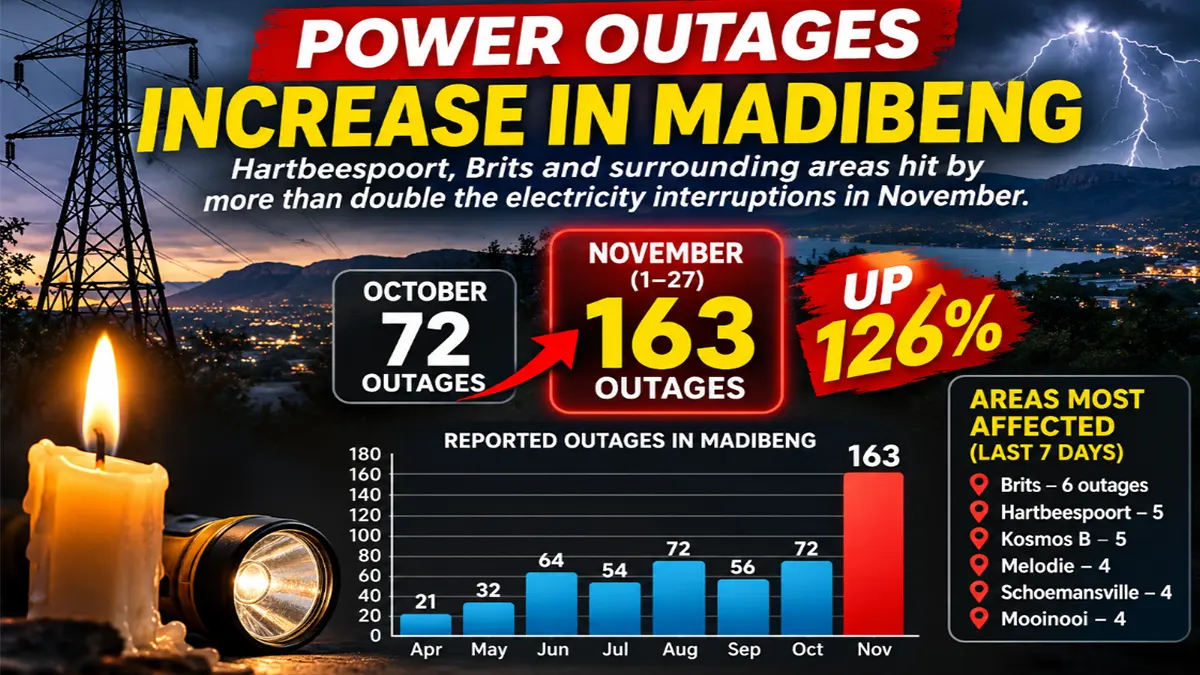
Residents and businesses across Madibeng are increasingly frustrated by electricity interruptions, with some communities experiencing several outages within a single week.
While thunderstorms, damaged power lines and transformer failures have been reported as possible causes of individual outages, official documentation from the National Energy Regulator of South Africa (NERSA) identifies ageing infrastructure and poor maintenance practices as significant risks within Madibeng’s electricity network.
Electricity failures more than double in November
According to community-generated outage monitoring data published by ESP, electricity interruptions across Madibeng have increased dramatically during November 2026.
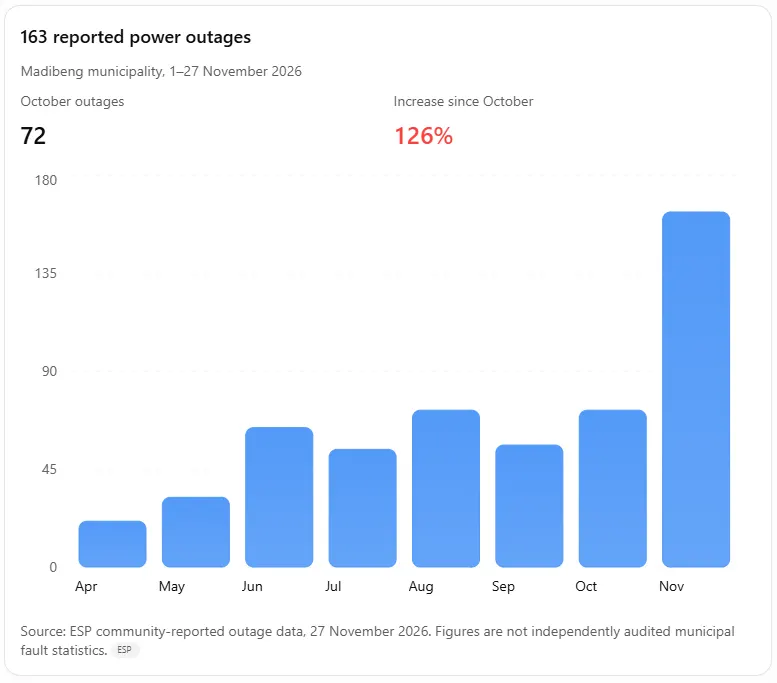
The monitoring platform recorded electricity interruptions across 32 areas during November, compared with 23 areas in October.
During the seven days leading up to 27 November, the following areas recorded repeated outages:
| Area | Reported outages |
|---|---|
| Brits | 6 |
| Hartbeespoort | 5 |
| Kosmos | 5 |
| Melodie | 4 |
| Schoemansville | 4 |
| Mooinooi | 4 |
These figures indicate the extent of the reported disruption, although community-generated data may be incomplete.
Repeated failures across the region
On 25 November, electricity interruptions were reported across Brits, including industrial areas, Bergsig, De Kroon, Primindia and Krokodildrift West. Community reports suggested that a substation was repeatedly tripping, although this has not been officially confirmed.
In Broederstroom, one resident reported being without electricity for 18 of the first 27 days of November. A technical team was reportedly dispatched on 26 November to investigate a power line fault.
Earlier in the month, suspected lightning damage to transformers was reported in the Brits area, while electricity interruptions also affected Zandfontein, Kosmos and Caribbean Beach.
On 27 November, further interruptions were reported in Gateway, Melodie and Zandfontein.
NERSA identifies serious maintenance concerns
Perhaps the most significant indication that the electricity crisis is not simply the result of bad weather can be found in NERSA’s decision document concerning Madibeng’s electricity tariff application for the 2026/27 financial year.
The regulator identifies several risks within Madibeng’s electricity operations, including:
-
Ageing electrical infrastructure.
-
Inadequate maintenance practices.
-
Excessive electricity distribution losses.
-
Illegal connections and overloaded infrastructure.
-
Poor revenue collection.
-
Substantial outstanding debt to Eskom.
-
Governance and regulatory compliance shortcomings.
The document also identifies Brits as a priority area for interventions to reduce electricity losses. Proposed measures include improvements to distribution lines, transformer capacity adjustments and preventative servicing.
Electricity losses remain alarmingly high
NERSA’s documentation reveals that Madibeng’s electricity losses remain substantial.
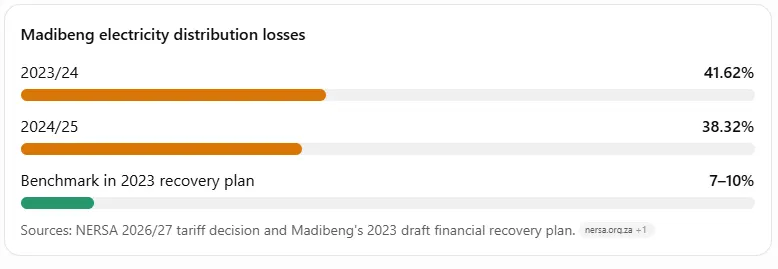
Electricity losses can result from inefficient infrastructure, illegal connections, meter tampering and billing irregularities.
Apart from placing additional strain on the network in some circumstances, these losses undermine the municipality’s financial ability to maintain and upgrade its electricity infrastructure.
Hartbeespoort’s infrastructure has long been under pressure
Concerns regarding Hartbeespoort’s electricity infrastructure are not new.
Madibeng’s draft 2024/25 Integrated Development Plan identified limited available capacity at the main Ifafi substation, with approximately 19 MVA of demand against a stated supply capacity of 20 MVA.
The document also identified the need for increased capacity and replacement of electrical switchgear at the substation.
Madibeng’s 2026/27 Integrated Development Plan refers to discussions between the municipality and the City of Tshwane regarding the transfer of the Ifafi substation and associated infrastructure.
Whether all the previously identified upgrades have since been completed remains unclear.
Illegal connections add to the problem
Illegal electricity connections are another factor contributing to the region’s electricity challenges.
In October 2026, widespread electricity interruptions in the Rietfontein area were linked in local media reports to illegal connections at the Ten Rooms informal settlement.
The situation resulted in community protests and road closures, with some residents reportedly experiencing prolonged electricity interruptions.
Illegal connections can overload transformers and distribution lines, causing equipment failures and creating dangerous conditions for residents and municipal workers.
Who is responsible?
One of the complications surrounding electricity supply in the Hartbeespoort and Brits region is that three different authorities are involved in electricity provision.
Madibeng Local Municipality, Eskom and the City of Tshwane are responsible for different parts of the distribution network.
Madibeng is a licensed electricity distributor serving areas including Brits, Hartbeespoort, Ifafi and Letlhabile, while Eskom supplies various rural communities and Tshwane is involved in electricity provision in parts of Hartbeespoort.
This division of responsibility makes coordination between the authorities essential, particularly when faults occur on infrastructure owned by one authority but supplying customers serviced by another.
The economic impact of recurring outages
The consequences of unreliable electricity extend far beyond the inconvenience of sitting in the dark.
Local businesses face additional expenditure on generators, diesel and backup power systems. Restaurants and supermarkets risk losing refrigerated stock, while farmers depend on electricity for irrigation, security and water supply.
Hartbeespoort’s tourism industry is also vulnerable to prolonged electricity interruptions, particularly over weekends and during the approaching festive season.
For ordinary households, repeated outages can damage electrical appliances, interrupt water supplies, compromise security systems and disrupt people working from home.
Infrastructure faults or maintenance backlogs?
The available evidence suggests that both are contributing factors.
While individual interruptions may be triggered by lightning, damaged cables, transformer failures or illegal connections, official regulatory and municipal documents establish that ageing equipment and inadequate maintenance are existing concerns.
A properly maintained and adequately sized electricity network should be better positioned to withstand adverse weather, increasing demand and unexpected equipment failures.
However, without detailed incident reports, maintenance records and infrastructure assessments from the relevant electricity authorities, it is impossible to determine how many of November’s outages could have been prevented.
The repeated failures raise important questions about whether sufficient resources are being invested in preventative maintenance rather than emergency repairs.
For residents of Hartbeespoort and Brits, restoring electricity after each breakdown is no longer enough. They need a sustainable solution that ensures a reliable electricity supply in the first place.