
Long before the first farmers, the armies of Mzilikazi or the ox wagons of the Voortrekkers arrived in the Magaliesberg, the valleys and hills surrounding present-day Hartbeespoort were part of a landscape inhabited by some of humanity’s earliest relatives. Their remarkable story stretches back millions of years and connects Hartbeespoort to one of the world’s most important regions for understanding human origins.
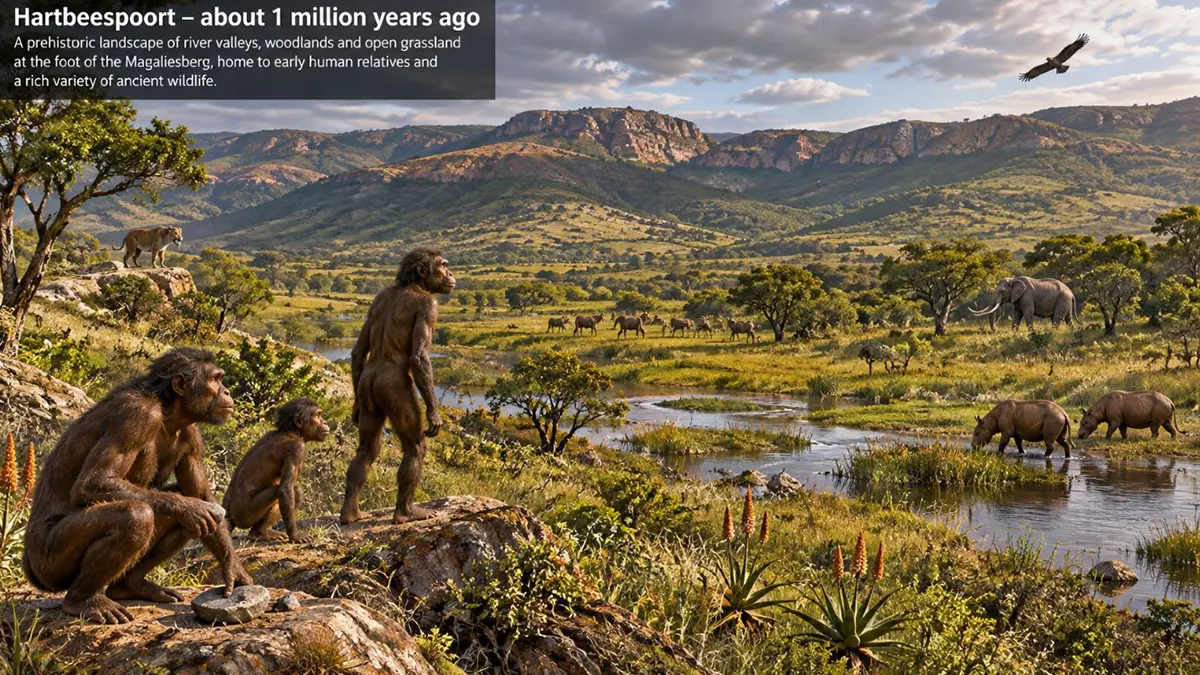
Today, Hartbeespoort is known for its dam, mountains, residential communities and tourist attractions. But beneath the familiar landscape lies a much older story — one that began long before modern humans existed.
Millions of years before the first Iron Age smiths worked their furnaces, before African farming communities established settlements in the valleys, before Mzilikazi’s Ndebele warriors crossed the region and before Boer settlers arrived with their horses and ox wagons, early human relatives inhabited the wider landscape south of the Magaliesberg.
These ancient beings were not modern humans. They belonged to different species of hominins — members of the evolutionary family that includes humans and our extinct close relatives.
Their fossilised remains have helped establish the region as one of the most important places on Earth for studying human evolution.
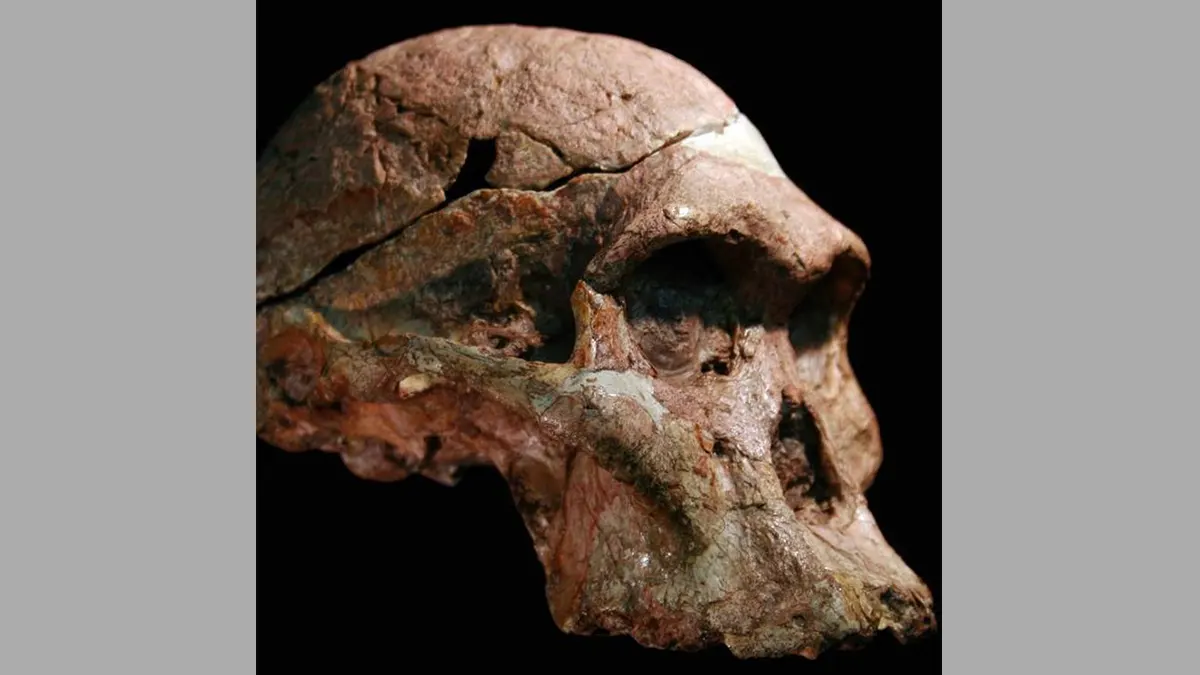
Mrs Ples, discovered in 1947
The Magaliesberg and the Cradle of Humankind
The mountains surrounding Hartbeespoort form part of a landscape with an extraordinary prehistoric heritage.
To the south-west lies the internationally recognised Cradle of Humankind, a UNESCO World Heritage Site containing some of the world’s richest collections of early hominin fossils.
The limestone caves at Sterkfontein, Swartkrans and Kromdraai, together with discoveries at Malapa and other sites, have provided scientists with invaluable evidence of how our distant relatives evolved, moved and survived.
Although the most famous fossil discoveries were made outside present-day Hartbeespoort, they offer a remarkable window into the prehistoric world of the wider Magaliesberg region.
The fossils do not prove that every species discovered in the Cradle lived at the exact location of today’s Hartbeespoort Dam. They do, however, establish that early hominins inhabited the surrounding region over millions of years.
Mrs Ples: The fossil that changed our understanding of human origins
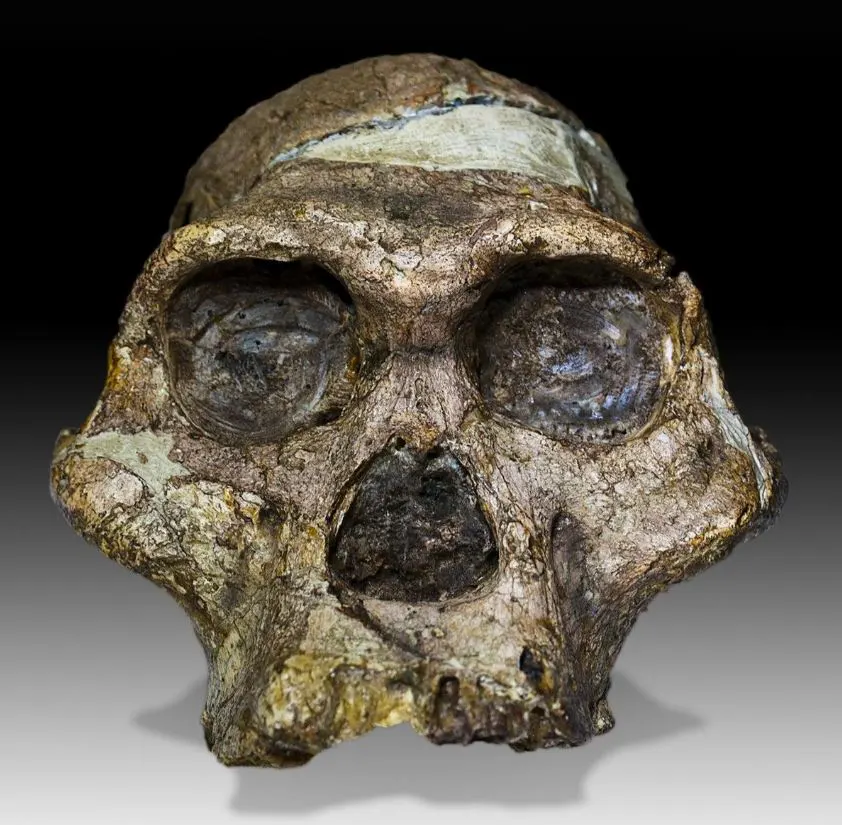
Mrs Ples, discovered in 1947
The famous Sterkfontein skull became one of South Africa’s most important fossil discoveries and helped demonstrate the antiquity of early human relatives in Africa.
One of the most important discoveries in the region occurred in April 1947, when palaeontologist Dr Robert Broom and his colleague John Robinson recovered a remarkably complete fossil skull from Sterkfontein.
The fossil, known scientifically as Sts 5, became famous as “Mrs Ples”.
Broom initially associated the specimen with the name Plesianthropus transvaalensis, meaning “near-human of the Transvaal”. It was subsequently classified as Australopithecus africanus.
For decades, the skull was believed to belong to an adult female, hence the affectionate nickname Mrs Ples.
However, researchers, including Professor Francis Thackeray of the University of the Witwatersrand, challenged this interpretation and suggested that the fossil may actually represent a young male — leading to the alternative nickname “Master Ples”.
The sex and developmental status of the specimen have remained subjects of scientific debate, and the traditional name Mrs Ples continues to be widely used.
The age of the fossil has also been debated. It was long described as approximately 2.1 million years old, but later dating research has suggested that some Sterkfontein fossils may be considerably older, potentially around 3.4 million to 3.7 million years.
These changing estimates illustrate how new scientific techniques continue to reshape our understanding of the region’s ancient history.
The Taung Child: A discovery the world initially ignored
More than two decades before Mrs Ples was discovered, another South African fossil had already challenged established ideas about human evolution.
In 1924, a fossilised skull belonging to a young child was recovered from a limestone quarry at Taung, in what is now North West province.
Professor Raymond Dart identified it as a previously unknown early human relative and formally described Australopithecus africanus in 1925.
The discovery was revolutionary.
At the time, many European scientists believed that humanity’s earliest ancestors had evolved elsewhere, particularly in Europe or Asia.
Dart’s discovery provided powerful evidence that Africa played a central role in human evolution.
Yet his findings were initially greeted with scepticism.
One reason was the influence of Piltdown Man, a supposed early human fossil discovered in England in 1912. Piltdown appeared to support prevailing expectations about human evolution but was exposed as a deliberate hoax in 1953.
The later discoveries at Sterkfontein helped vindicate Dart’s interpretation and establish southern Africa as a major centre of palaeoanthropological research.
How did the first inhabitants live?
The prehistoric Magaliesberg landscape would have looked very different from the towns, roads and agricultural fields that occupy it today.
Early hominins lived in environments that changed over time, including woodland, bushveld and more open grassland habitats.
They shared their surroundings with a variety of wild animals, including large predators.
Life was dangerous, and survival depended on finding food, avoiding predators and adapting to environmental changes.
Scientists have studied fossil teeth, bones, ancient sediments and stone tools to reconstruct aspects of these early lives.
Evidence suggests that Australopithecus africanus had a varied diet, including plant foods and possibly animal-derived foods.
Some researchers have proposed that early hominins scavenged carcasses left by predators, obtaining nutritious meat and bone marrow.
However, the precise extent of scavenging, hunting and tool use by Australopithecus africanus remains uncertain.
Stone tools discovered at archaeological sites in the wider region provide important evidence of later early-human behaviour, but not all these tools can be confidently attributed to Australopithecus africanus.
The ability to exploit different food sources may have been an important advantage in an unpredictable environment.
Could these early ancestors communicate?
One of the most fascinating questions concerns the ability of early hominins to communicate.
Professor Francis Thackeray and other researchers have investigated fossil skulls and brain anatomy to explore the possible development of communication abilities.
Modern imaging techniques allow scientists to study the internal surfaces of fossil skulls and produce digital reconstructions of ancient braincases.
Such research can provide clues about brain structure, but it cannot establish whether a particular early hominin species possessed spoken language.
It is possible that Australopithecus africanus used vocalisations, gestures and other forms of social communication.
However, the complex language abilities of modern humans cannot be confidently attributed to Mrs Ples or other australopithecines.
The development of language remains one of the great unresolved questions in human evolutionary research.
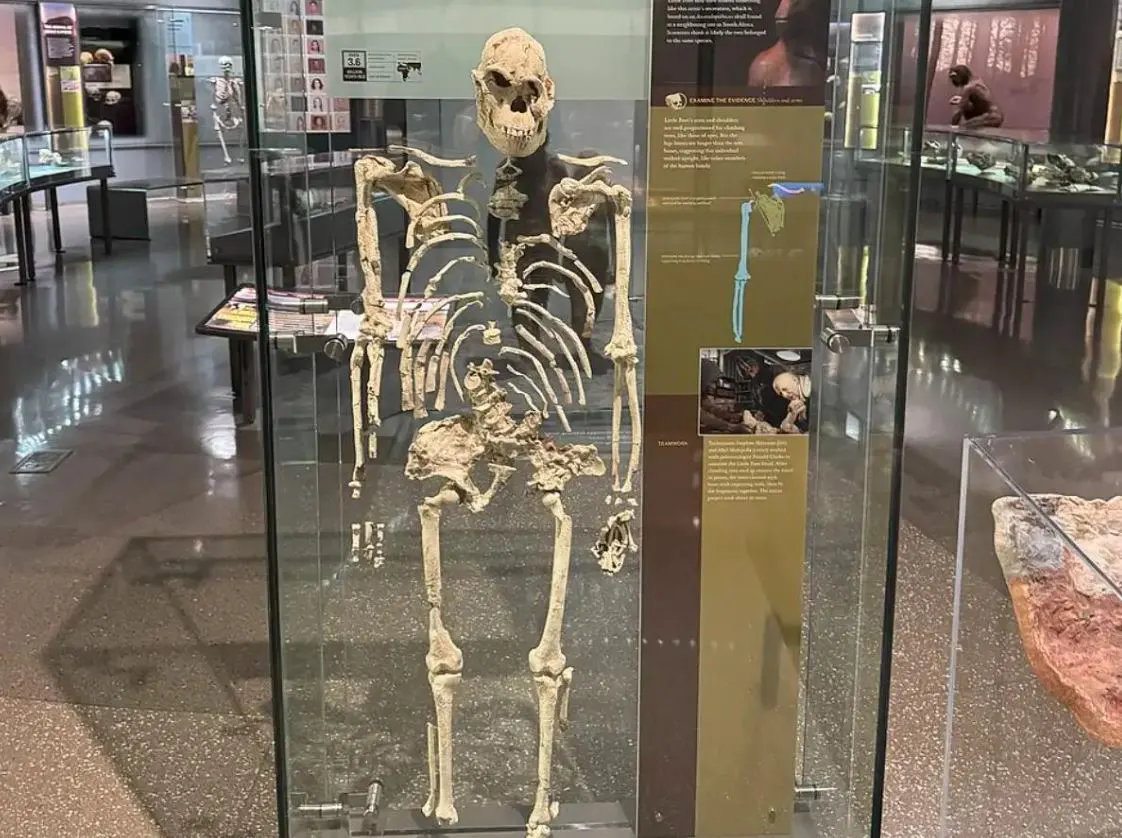
Little Foot — approximately 3.67 million years old
One of the most complete australopithecine skeletons ever discovered, offering remarkable evidence of early upright walking and climbing abilities.
Another extraordinary discovery at Sterkfontein was the fossil skeleton known as Little Foot.
First identified from foot bones in 1994 by Professor Ron Clarke, the specimen eventually yielded a remarkably complete skeleton.
Little Foot is approximately 3.67 million years old according to cosmogenic burial dating, although aspects of its classification and geological context have been debated.
Its skeleton provides evidence that early hominins could walk upright while retaining physical adaptations useful for climbing trees.
The discovery transformed scientists’ understanding of how early human relatives moved through their environments.
A 2024 study by Professor Thackeray also supported an age of approximately 3.6 million years for Little Foot.
Australopithecus sediba: Another branch of the family tree
In 2008, fossils discovered at Malapa in the Cradle of Humankind revealed another remarkable early human relative.
Named Australopithecus sediba, the species lived approximately 1.98 million years ago.
The fossils included remains of a juvenile male, nicknamed Karabo, and an adult female.
The species displayed an unusual combination of primitive and more human-like anatomical features.
Some aspects of its hands, pelvis and other skeletal structures suggested adaptations that scientists consider important in the evolution of later humans.
However, researchers continue to debate exactly where Australopithecus sediba belongs on the human family tree.
The discovery demonstrated that several different forms of early hominins lived in southern Africa over time, and that human evolution was far more complicated than a simple progression from ape to modern human.
The robust hominins of Swartkrans
Another important species found in the wider region was Paranthropus robustus, previously also classified within Australopithecus.
These hominins lived roughly between two million and one million years ago.
They had powerful jaws, large back teeth and skull adaptations associated with strong chewing muscles.
Their specialised anatomy suggests that they were adapted to processing a range of challenging foods.
Fossils from Swartkrans and other sites show that different hominin lineages occupied the region during overlapping periods.
Some of these species eventually disappeared, while the evolutionary lineage leading to modern humans survived.
The exact relationships between these ancient populations remain subjects of ongoing research.
From early hominins to the first modern people
Millions of years passed between the earliest hominins of the Cradle of Humankind and the appearance of our own species, Homo sapiens.
Modern humans emerged in Africa approximately 300,000 years ago.
Over many thousands of years, hunter-gatherer communities occupied different parts of southern Africa, adapting to local environments and making increasingly sophisticated stone tools.
The ancestors of the San were among the region’s early modern human populations.
These communities possessed extensive knowledge of plants, animals, seasonal water sources and the natural landscape.
They hunted wild animals, gathered edible plants and maintained complex cultural traditions.
Rock paintings and engravings found across southern Africa provide evidence of the spiritual beliefs, artistic abilities and social lives of hunter-gatherer communities.
Although the Magaliesberg region forms part of this wider history, the precise dates and identities of its earliest modern human communities cannot always be established.
The first farmers arrive in the Magaliesberg
One of the most significant developments in the human history of the Hartbeespoort area occurred approximately 1,500 years ago.
Early farming communities began establishing permanent settlements in the region.
Unlike the earlier hunter-gatherers, these communities cultivated crops, kept livestock and produced pottery and iron implements.
One of the most important archaeological sites is at Broederstroom, near Hartbeespoort Dam.
Excavations at Broederstroom provided some of the earliest recognised evidence of Early Iron Age farming communities in the interior of South Africa.
The discoveries helped archaeologists understand how early farmers established settlements, produced iron tools and organised their daily lives.
Their settlements included houses, grain-storage facilities and livestock enclosures.
The inhabitants cultivated crops and used iron hoes to work the soil.
The availability of water, fertile land and natural resources made the valleys around the Magaliesberg attractive places to settle.
The Broederstroom discoveries are particularly significant because they provide direct archaeological evidence of early farming communities in the immediate Hartbeespoort area.
The people who came before Mzilikazi
Over the following centuries, farming and herding communities continued to occupy the Magaliesberg valleys.
Different groups established settlements, developed trade relationships and adapted to the landscape.
Tswana-speaking communities became particularly important in the region’s later precolonial history.
By the time Mzilikazi and his Ndebele followers entered the wider region during the 1820s and 1830s, the Magaliesberg was far from an uninhabited wilderness.
It was already a landscape with a long history of settlement, agriculture, livestock farming and political organisation.
The arrival of the Ndebele, followed by the Voortrekkers, brought major political and social changes.
But these events represented only the most recent chapters in a story stretching back millions of years.
Hartbeespoort: More than a century of history
The construction of Hartbeespoort Dam in the early 20th century transformed the landscape, creating the water body that would eventually become the centre of a thriving residential and tourism region.
Yet the history of the area did not begin with the dam, the first farms or the establishment of its modern suburbs.
It began in an ancient landscape inhabited by early human relatives, followed much later by hunter-gatherers, herders and farming communities.
The mountains, valleys and waterways that residents see today are part of that extraordinary heritage.
The discoveries at Sterkfontein, Swartkrans, Malapa and Broederstroom remind us that Hartbeespoort lies close to one of the most scientifically significant landscapes in the world.
Long before there was a Hartbeespoort Dam, before the first villages or cultivated fields, and before the Magaliesberg acquired its present name, the wider region was already part of the unfolding story of humanity.
The history of Hartbeespoort is therefore not merely measured in centuries — it is connected to millions of years of human evolution.
Historical timeline: The first inhabitants of the Magaliesberg
| Period | Major development |
|---|---|
| Approximately 3.7 million years ago | Little Foot and other early hominins inhabited the wider Sterkfontein region |
| Approximately 3.4–3.7 million years ago | One published dating estimate for the deposits containing Mrs Ples |
| Approximately 2 million years ago | Australopithecus sediba and other hominins lived in the wider region |
| Approximately 2–1 million years ago | Paranthropus robustus inhabited southern Africa |
| Approximately 300,000 years ago | Homo sapiens emerged in Africa |
| Later Stone Age | Hunter-gatherer communities occupied southern African landscapes |
| Around the 5th–7th centuries AD | Early Iron Age farming communities established settlements around Broederstroom |
| 1820s–1830s | Mzilikazi’s Ndebele kingdom became a major regional power |
| 1830s onward | Voortrekker settlement brought further changes |
| 20th century | Construction of Hartbeespoort Dam transformed the area |
Editorial note: The original historical material included older estimates for Little Foot and Mrs Ples, and some disputed claims about their sex, tool use and language. These have been updated or qualified to reflect the published research. The article also distinguishes fossil evidence from the wider Cradle of Humankind from archaeological evidence found directly around Hartbeespoort.