Election posters: The good, the bad and the politicians on poles
It’s election season, and South Africa’s lampposts are about to become the most sought-after real estate in town. But before politicians start climbing poles to plaster their smiling faces across Hartbeespoort, there are a few rules they should know.
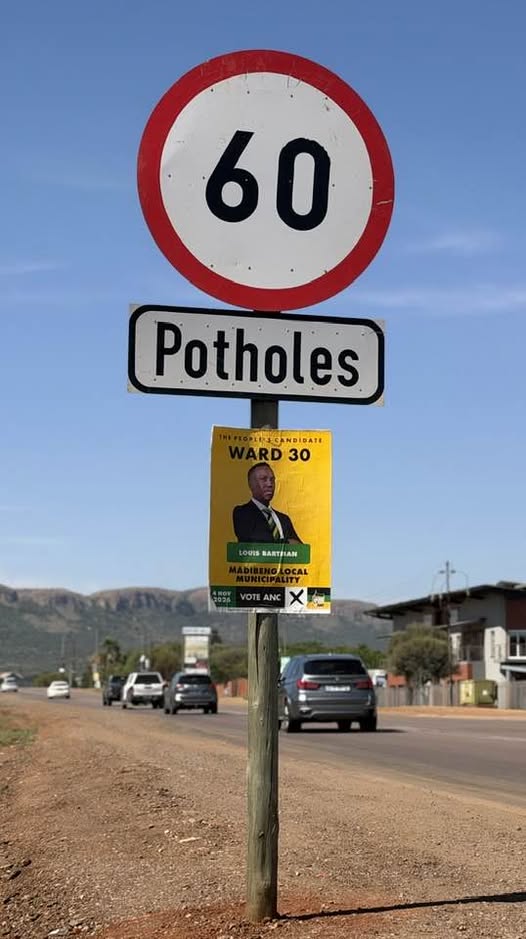
There comes a time in every South African election cycle when our streets undergo a remarkable transformation.
Overnight, ordinary lampposts become political billboards, electricity poles develop personalities, and every street corner suddenly features a smiling politician promising a brighter future.
Some faces are familiar. Others leave residents wondering whether they are running for mayor or advertising a new dental practice.
And then there are the posters that remain long after the election, their faded smiles watching over potholes that have survived three municipal administrations.
But believe it or not, there are rules governing this colourful invasion of our streets.
And no, “find a pole and claim it” is not one of them.
Rule number one: Not every pole is fair game
Contrary to popular political belief, a lamppost is not automatically public advertising space.
Political parties generally need to comply with the relevant municipality’s outdoor advertising by-laws, which determine where election posters may be displayed, how they must be attached and whether permission is required.
Some municipalities allow election posters on designated streetlight poles under specific conditions. Others impose restrictions on locations, sizes and the number of posters permitted.
In other words, just because a pole is standing there looking lonely doesn’t mean it is available.
And attaching a poster to someone’s private fence without permission is not a clever campaign strategy. It’s trespassing into someone else’s advertising space.
Rule number two: Please don’t electrocute yourself
Election campaigns can be electrifying, but preferably not literally.
Posters must not interfere with electrical infrastructure, traffic signals or other municipal equipment.
Climbing electricity structures or attaching materials to dangerous electrical installations is a particularly bad idea.
Political ambition is admirable. Becoming a human lightning conductor is not.
Rule number three: Road signs are not campaign managers
Election posters must not obstruct road signs, traffic lights or motorists’ visibility.
A poster covering a STOP sign is not political advertising. It’s a traffic hazard.
Likewise, a candidate’s smiling face should not be positioned where drivers need to see approaching vehicles or pedestrians.
Democracy is important, but so is arriving home in one piece.
Rule number four: Size does matter
Municipal by-laws may prescribe maximum poster dimensions, minimum heights above pavements and restrictions on how many posters may be attached to a single pole.
These requirements differ between municipalities.
The idea is to prevent election campaigns from turning public streets into giant paper jungles.
After all, there is only so much room on a lamppost, especially when six political parties are convinced that their candidate deserves the top position.
Rule number five: Hands off the opposition’s posters
Election campaigns can become heated, but removing, damaging or defacing another party’s election posters is not an acceptable form of political debate.
South Africa’s Electoral Code of Conduct prohibits the unlawful removal, defacement or destruction of election materials belonging to other parties.
So, if you dislike the face smiling down at you from a streetlight, resist the temptation to improve the poster with a marker pen.
Drawing a moustache on a political opponent might earn a few laughs, but it could also land you in trouble.
Democracy means allowing people to express political views, even when their posters are exceptionally unflattering.
Rule number six: The election ends. So must the posters.
This is perhaps the most interesting rule of all.
Once the votes have been counted, political parties cannot simply abandon their posters to the wind, rain and African sun.
Municipal by-laws generally require election posters to be removed within a specified period after polling day.
The exact deadline depends on the municipality.
Failing to remove them can result in municipal enforcement action and, where the applicable by-law provides for it, fines or removal costs.
Unfortunately, some posters seem to believe they have been elected for life.
Months after an election, faded candidates can still be seen hanging sideways from poles, their promises slowly dissolving in the summer rain.
Perhaps the most effective campaign slogan would be: “Vote for us. We promise to remove our posters.”
Rule number seven: Trees don’t vote
Trees, parks and other public spaces may be protected by municipal advertising rules.
Nailing campaign posters into trees or damaging vegetation to display political advertising can contravene local regulations.
Trees have enough problems dealing with drought, invasive pests and the occasional chainsaw.
They really don’t need political campaign material nailed to their trunks.
And while trees cannot vote, the people who care about them certainly can.
Rule number eight: Keep the campaign clean
South Africa’s electoral rules require political parties and candidates to respect the rights of others and refrain from intimidation and prohibited conduct.
Political advertising must also comply with applicable laws.
There is a difference between robust political debate and threatening opponents or deliberately misleading voters.
A good election poster should persuade voters, not frighten them.
Although, judging by some campaign photographs, the frightening part may be unavoidable.
Who polices the posters?
The Independent Electoral Commission (IEC) oversees elections and administers the Electoral Code of Conduct, while municipalities are generally responsible for enforcing their outdoor advertising by-laws.
That means a complaint about an illegally positioned poster will usually be a municipal matter.
A complaint about intimidation, interference with campaigning or unlawful destruction of election material may involve electoral authorities or law enforcement.
Residents should report suspected violations rather than taking matters into their own hands.
After all, removing a poster because you believe it is illegal could create a completely different problem.
Hartbeespoort’s great pole position contest
As election fever approaches, Hartbeespoort residents can probably expect the usual colourful collection of campaign posters.
From Schoemansville to Meerhof, from Ifafi to Kosmos, every strategically positioned lamppost may suddenly become prime political property.
Some candidates will promise better roads. Others will promise improved services, cleaner neighbourhoods and functioning infrastructure.
And somewhere, beneath a smiling face promising to fix the potholes, there will probably be a pothole.
The irony will be lost on absolutely nobody.
A final word to our aspiring politicians
Dear candidates, we appreciate your enthusiasm.
We understand that elections are competitive and that every poster represents an opportunity to win a vote.
But please remember a few simple things.
Don’t block the traffic signs. Don’t damage the trees. Don’t interfere with electrical infrastructure. Don’t vandalise your opponents’ posters.
And, most importantly, when the election is over, take your face home.
Because while democracy may be permanent, your election poster certainly shouldn’t be.
And to the voters of Hartbeespoort: Remember, the person with the biggest poster isn’t necessarily the person with the biggest plan.
Sometimes, it’s simply the person with the longest ladder.