Tiny warriors take on Hartbeespoort Dam’s hyacinth invasion
Millions of tiny insects are fighting one of Hartbeespoort Dam’s biggest environmental problems — one hyacinth plant at a time
HARTBEESPOORT — They are barely 3 mm long, easily overlooked and certainly don’t look like formidable environmental warriors.
Yet the tiny water hyacinth hopper, Megamelus scutellaris, has become one of the most important weapons in the continuing battle against water hyacinth on Hartbeespoort Dam.
While residents and visitors see vast green mats spreading across the water, another battle is taking place almost invisibly among the leaves.
Thousands of hoppers are feeding, breeding and multiplying — slowly weakening the invasive plants from within.
And when their numbers become large enough, the results can be dramatic.
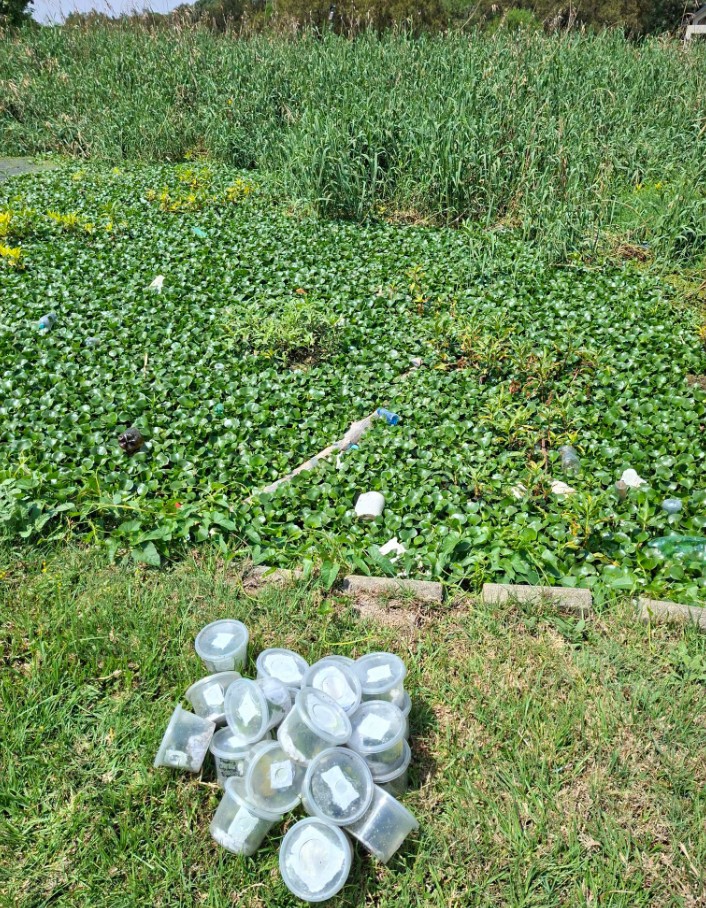
Hoppers reared by the CBC in Makhanda at @RhodesUniversity about to be released onto the dam
A tiny enemy for a giant problem
Water hyacinth has plagued Hartbeespoort Dam for decades.
The invasive South American aquatic plant thrives in the dam’s warm, nutrient-rich water and can spread extraordinarily quickly when conditions are favourable.
The same South American ecosystem that produced the plant, however, also produced some of its natural enemies.
One of them is Megamelus scutellaris.
The insect was approved for release in South Africa in 2013 after host-specificity testing. It has since become established at numerous sites around the country. Research published in African Entomology reported that more than a million of the insects had been mass-reared and released nationally, with overwintering populations established at 32 sites in seven provinces.
Unlike a general garden pest, the hopper is highly specialised.
It feeds on water hyacinth by inserting its piercing mouthparts into the plant’s vascular tissue and sucking sap. The resulting feeding damage places the plant under stress and can also create wounds through which plant pathogens can enter.
One hopper will not kill a dam full of hyacinth.
But hundreds of thousands — followed by rapidly multiplying generations — can have a very different effect.
“It is a numbers game. The more hoppers that become established on the hyacinth, the greater the pressure on the plants.”
Hartbeespoort becomes a biological-control battleground
Hartbeespoort Dam has become one of South Africa’s most important examples of large-scale biological control of water hyacinth.
Inundative releases of Megamelus at the dam began in 2018. Instead of releasing a small population and simply waiting for it to multiply naturally, scientists repeatedly introduced large numbers of insects.
The results demonstrated the potential of the approach.
Research reported that repeated inundative releases reduced water hyacinth cover from more than 37% to less than 6% over two consecutive years. South Africa’s Department of Forestry, Fisheries and the Environment has described the Hartbeespoort results as a major breakthrough in water hyacinth control.
But anyone living around Hartbeespoort knows that the story did not end there.
The hyacinth returned.
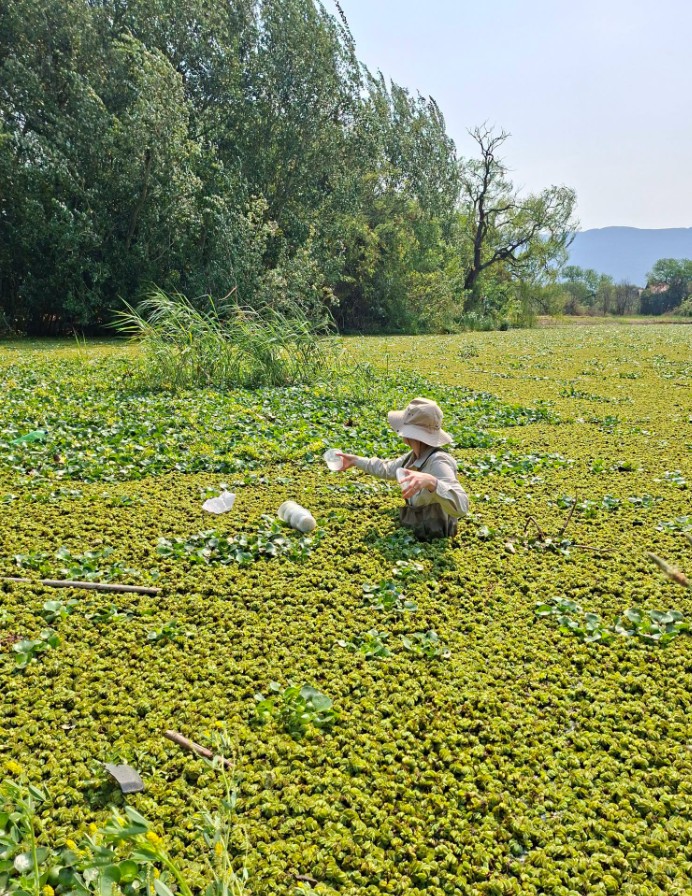
Dr Kelby English releasing the hoppers onto the emerging water hyacinth
Why does the hyacinth keep coming back?
The answer lies partly beneath the water.
Water hyacinth has been present at Hartbeespoort for decades and has produced enormous quantities of seed. When conditions become favourable, seeds in the sediment can germinate and create a new generation of plants.
Warm temperatures, sunlight and the dam’s nutrient-rich water can then fuel rapid growth.
At the same time, Hartbeespoort’s cold winters can reduce hopper populations.
This means the hyacinth may get a head start in spring before Megamelus numbers have recovered sufficiently to exert strong pressure on the plants.
Research elsewhere in South Africa has shown that cold winter conditions can cause major declines in hopper populations and delay their recovery the following season. Supplementary releases in spring can help overcome that lag.
That is why mass-rearing programmes are so important.
Rather than waiting months for a small surviving population to multiply naturally, researchers and local rearing stations can introduce thousands of additional insects directly onto newly developing hyacinth.
Harties residents join the fight
The battle is not being fought by scientists alone.
Community-based rearing stations around Hartbeespoort have helped maintain populations of the insects so they can be released when new hyacinth appears.
In August and September 2024, for example, more than 60,000 Megamelus were released after new seedlings were detected. The insects had been maintained through winter at satellite rearing stations around the dam.
The programme continued during 2025. In October that year, the Centre for Biological Control reported releases of around 12,000 hoppers per week in cooperation with Magalies Water, while community rearing stations were also making weekly releases.
By December 2025, researchers were still making large releases. GroundUp documented approximately 20,000 insects being released during one operation at Hartbeespoort Dam.
It illustrates one of the most interesting aspects of the programme: local residents can participate directly in biological control by helping rear the insects that eventually end up on the dam.
How does something so small kill something so big?
The hopper doesn’t attack the plant in the spectacular way that a caterpillar devours a leaf.
Instead, the damage accumulates.
Both adults and nymphs feed on the leaves and petioles of water hyacinth.
As hopper populations increase, hundreds or thousands may occupy a relatively small area of plants. Continuous feeding drains resources from the hyacinth and reduces its vigour.
Eventually plants can become yellow, stressed and weakened.
Under sufficiently heavy biological-control pressure, sections of a dense hyacinth mat can deteriorate and collapse.
The insects themselves are remarkably well adapted to exploiting the plant.
Adults are approximately 3 mm long and vary from pale cream to dark brown. Interestingly, adults may occur in winged or short-winged forms.
When plant quality deteriorates, the proportion of winged adults can increase — allowing the insects to disperse in search of better water hyacinth.
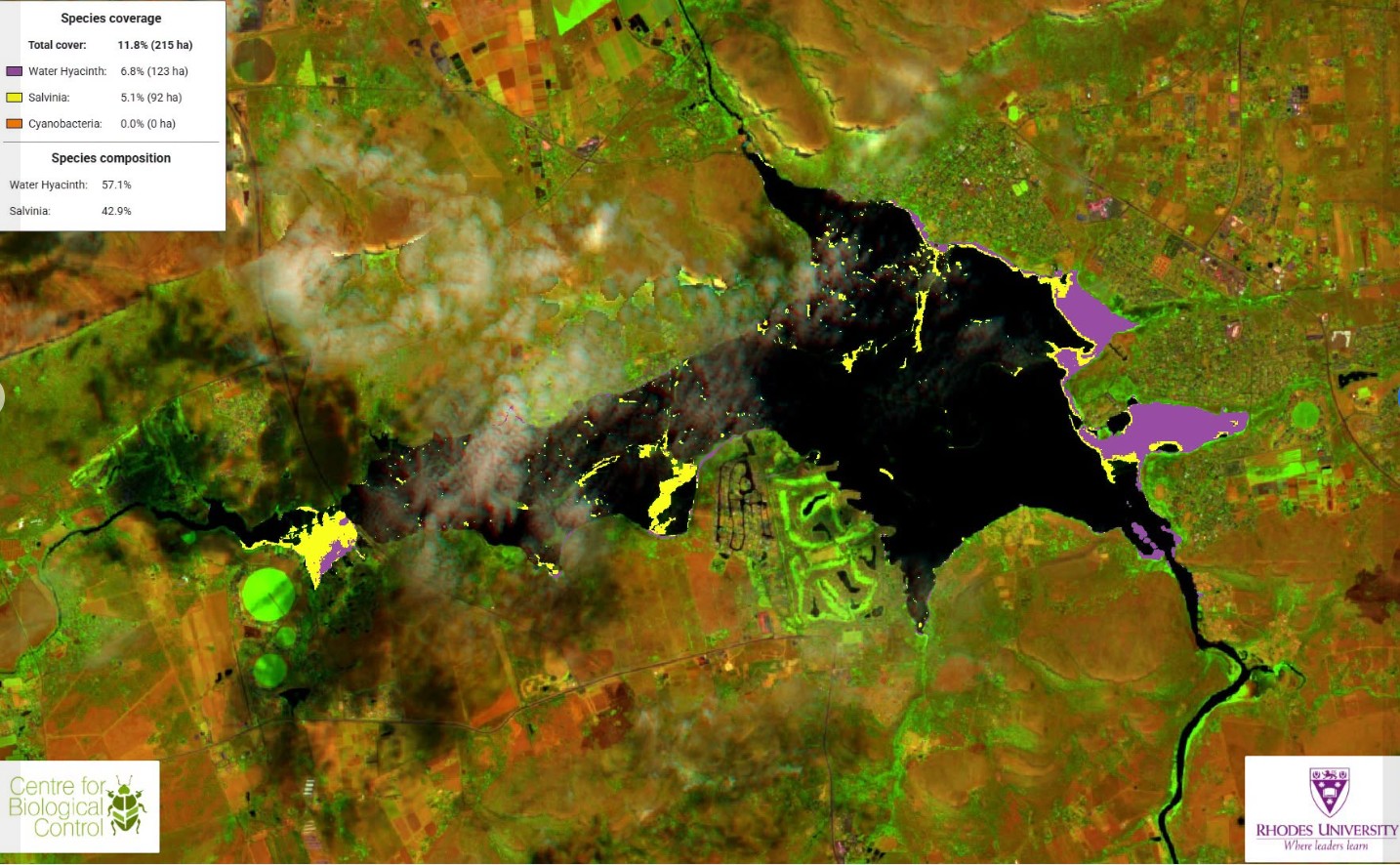
Salvinia (yellow) has declined from 40% to just 5%, while water hyacinth (purple) is on the increase
The real problem is still flowing into the dam
The success of the hoppers should not obscure the larger environmental problem facing Hartbeespoort.
Water hyacinth is exceptionally successful in nutrient-rich water.
The dam receives high nutrient loads, including nitrogen and phosphorus associated with wastewater and other sources entering the catchment. Those nutrients effectively fertilise aquatic plant growth.
Biological control can therefore help manage the weed, but it cannot solve the underlying water-quality problem.
As long as Hartbeespoort remains nutrient-rich, conditions will continue to favour rapid growth of water hyacinth and other aquatic organisms.
The long-term rehabilitation of the dam consequently requires more than fighting the plants visible on its surface.
It requires addressing what is entering the water upstream.
Hartbeespoort’s smallest environmental workers
Next time a mat of water hyacinth drifts past the shoreline, look closely.
Among the glossy green leaves there may be another world operating almost unnoticed.
Tiny pale and brown insects may be crawling along the stems. Females may be laying eggs inside plant tissue. Nymphs may be feeding nearby. Another generation may already be developing.
Each insect is insignificant on its own.
Together, they can become a biological army.
And on Hartbeespoort Dam, some of the smallest creatures on the water have become important participants in one of the biggest environmental battles facing the community.
KNOW YOUR HOPPER
The life cycle of Megamelus scutellaris
EGGS — 7 to 13 days
Female hoppers insert their tiny eggs into water hyacinth tissue, generally around the base of the leaf. The eggs are approximately 1 mm long and usually hatch after about 7–13 days.
NYMPHS — five stages
After hatching, the young insects are called nymphs. They resemble miniature adults and immediately begin feeding on the water hyacinth.
They pass through five developmental stages, or instars, becoming larger each time they moult.
ADULT — about 3 mm long
The mature hopper is only about 3 mm long.
Adults range from pale cream to dark brown and can occur in winged and short-winged forms. Adults may live for as long as 80 days under suitable conditions.
AND THEN IT STARTS AGAIN…
Females lay more eggs and another generation begins.
Because Megamelus has a relatively short life cycle and overlapping generations, its population can increase rapidly when temperatures and plant conditions are favourable.
THE CYCLE
EGG → NYMPH → 5 GROWTH STAGES → ADULT → EGGS
The faster the population grows, the more feeding pressure is placed on the hyacinth.
DID YOU KNOW?
The water hyacinth hopper is not a mosquito, flea or biting insect. It is a tiny plant-feeding insect specifically associated with water hyacinth and was subjected to host-specificity testing before being approved as a biological-control agent in South Africa.